
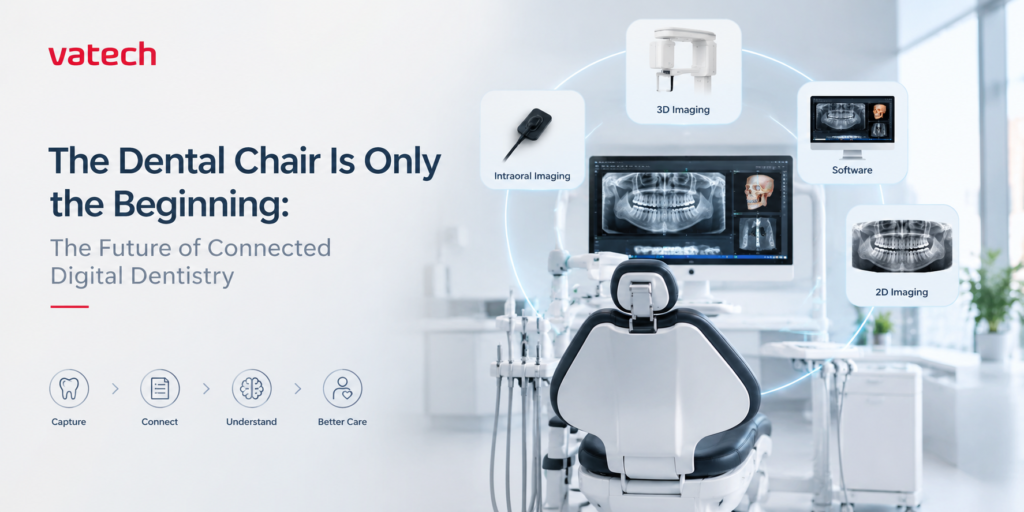
Why the modern dental practice needs more than individual devices
For generations, the dental chair has been the centre of the dental practice.
It is where the patient sits.
It is where examination happens.
It is where treatment is delivered.
But modern dentistry no longer begins and ends at the chair.
Before a procedure, there is patient history, examination and imaging. During diagnosis, there may be intraoral radiographs, panoramic imaging or CBCT. Treatment planning may involve multiple sources of clinical information. After diagnosis, those same images become part of the conversation between dentist, patient, specialist and laboratory.
The dental chair is still where dentistry happens. But increasingly, the information around it shapes how dentistry happens.
And that changes the way dental technology should be evaluated.
The problem isn’t a lack of technology
Walk into a modern dental practice and you may find an impressive collection of digital equipment.
An intraoral sensor.
An OPG.
A CBCT.
Perhaps an intraoral scanner.
Different software platforms.
Different viewers.
Different systems storing different pieces of information.
Each device may perform its intended function very well.
Yet the overall workflow can still feel disconnected.
The dentist may have excellent images but spend time moving between systems.
The team may have digital equipment but still rely on manual steps to organise information.
The patient may see several different images without understanding how they relate to one another.
This is the paradox of digital dentistry:
A practice can have more technology and still have a fragmented workflow.
That is why the conversation around digital dentistry is gradually moving beyond simply acquiring more devices.
The more important question is becoming:
How well does the technology work within the clinical workflow?
Digital does not automatically mean connected
There is an important distinction between being digital and being connected.
Digital means information is captured, stored or processed electronically.
Connected means that information can become useful across different stages of the clinical journey.
Consider an implant case.
The patient may begin with a clinical examination and an intraoral radiograph. A panoramic image may provide a broader view. CBCT may then be required for three-dimensional assessment and treatment planning.
The value is not in having three separate images.
The value is in how those images contribute to one clinical decision.
The same principle applies to orthodontics, endodontics, oral surgery, prosthodontics and restorative dentistry.
Technology becomes more valuable when it helps the dentist move from:
Image → Information → Understanding → Decision.
The FDI World Dental Federation’s 2025 policy statement on digital dentistry similarly emphasizes evidence-based, patient-centred and outcome-driven use of digital technologies, alongside interoperability and continued professional judgment.
The dentist doesn’t need more information. The dentist needs useful information.
This is where technology companies have an important responsibility.
It is easy to add features.
It is much harder to make technology genuinely useful.
A CBCT system should not simply produce a three-dimensional image. It should help answer a clinical question.
An OPG should not simply generate a panoramic image. It should become part of diagnosis and treatment planning.
An intraoral sensor should not simply capture an X-ray. It should make acquisition efficient and the resulting image clinically useful.
Software should not become another layer of complexity. It should help clinicians access, interpret and work with the information they have already captured.
The objective is not more technology.
The objective is better clinical utility.
This is where Vatech’s approach matters
For a dentist evaluating imaging technology, the decision should go beyond comparing one specification with another.
It should begin with a more fundamental question:
What kind of imaging ecosystem do I want to build for my practice?
This is where Vatech becomes relevant.
Vatech’s dental portfolio spans 2D imaging, 3D imaging, intraoral imaging and software, giving dentists options across different stages of their imaging journey.
From intraoral imaging for everyday diagnostic needs to panoramic systems and CBCT for more advanced clinical applications, the portfolio is built around the different imaging requirements of modern dentistry.
The significance of this breadth is not simply that there are multiple products to choose from.
It is that a dentist can think about imaging as a long-term technology strategy, rather than as a series of unrelated purchases.
Start with the clinical question, not the machine
Suppose a dentist is considering a CBCT.
The first question should not be:
“Which CBCT has the largest FOV?”
It should be:
“What clinical cases do I want this system to help me manage?”
Implant planning?
Endodontics?
Impacted teeth?
Orthodontics?
Or a combination of applications?
The appropriate FOV, resolution, workflow, software and system configuration should follow from that clinical requirement.
The same principle applies to every imaging investment.
A practice should not buy technology simply because it is newer.
It should buy technology because it solves a meaningful clinical or workflow problem.
That is why Vatech’s broad imaging portfolio matters.
It allows practices to evaluate their imaging requirements across intraoral, 2D and 3D technologies rather than looking at every imaging need in isolation.
Image quality is important. What you do with the image is equally important.
For a long time, conversations about dental imaging focused heavily on image quality.
And rightly so.
But image quality is only the beginning.
Once an image has been captured, the dentist needs to work with it.
It needs to be viewed.
It needs to be interpreted.
It may need to be compared with other clinical information.
It may need to be explained to the patient.
It may need to support treatment planning.
And sometimes it needs to be shared with another professional.
That is why imaging software and viewing environments are becoming increasingly important parts of the digital dental workflow.
Vatech’s software portfolio includes image-processing and machine-learning technologies designed to support dental imaging workflows.
The larger idea is simple:
The value of an imaging system should not stop when the exposure ends.
The patient is part of the digital workflow too
There is another benefit of better imaging that is often underestimated:
Communication.
A patient may not understand a clinical explanation involving bone levels, root anatomy, an impacted tooth or a periapical lesion.
But showing the patient the relevant image can change the conversation.
Instead of asking the patient to imagine the problem, the dentist can show it.
Instead of simply recommending treatment, the dentist can explain the clinical reasoning behind it.
Technology therefore has a role not only in diagnosis, but also in making diagnosis understandable.
The image is no longer only something the dentist sees.
It can become part of what the patient understands.
Why choose Vatech?
This brings us to the question that every dentist should ask before making a technology investment:
Why this manufacturer?
The answer should never be simply a brand name.
It should come down to what the technology can contribute to the practice.
For a dentist considering Vatech, there are several factors worth evaluating.
A broad imaging portfolio
Vatech offers dental imaging solutions across intraoral, 2D and 3D imaging, allowing practices to select technology according to their clinical requirements.
Clinical relevance
Imaging technology should serve clinical decision-making rather than simply add another piece of equipment to the practice.
Imaging supported by software
The workflow does not end with image acquisition. Viewing, processing and working with diagnostic information are equally important parts of the experience.
A technology roadmap
A dental practice rarely stays exactly the same.
The cases change.
The team grows.
The procedures evolve.
The imaging requirements become more sophisticated.
Technology therefore needs to be considered as part of the practice’s future—not only its present.
The smarter investment is not always the most expensive one
There is a temptation in digital dentistry to equate advancement with complexity.
The newest technology.
The largest specifications.
The most features.
But the best technology investment is not necessarily the one with the longest specification sheet.
It is the one that answers the practice’s clinical needs while fitting the way the team actually works.
Before investing, dentists should ask:
What clinical problems am I trying to solve?
Which imaging modality do I actually need?
How will the system fit into my existing workflow?
What software and viewing tools will my team use?
How easily can the information be accessed, interpreted and communicated?
What training and technical support are available in my market?
Can this investment continue to make sense as my practice grows?
These questions move the conversation away from simply buying equipment.
They move it towards building a practice.
The dental chair is only the beginning
The future of dentistry will not be defined by how many digital devices a practice owns.
It will be defined by how effectively those technologies support the clinical journey.
From the first image to diagnosis.
From diagnosis to treatment planning.
From treatment planning to patient communication.
From one clinical decision to the next.
The dental chair remains at the centre.
But the technology surrounding it increasingly determines how efficiently information moves through the practice and how effectively that information can be turned into clinical action.
That is why choosing imaging technology is no longer simply a purchase decision.
It is a workflow decision.
It is a clinical decision.
And increasingly, it is a long-term practice decision.
Vatech’s portfolio across intraoral, 2D and 3D dental imaging gives dentists the opportunity to approach that decision with more than a single machine in mind.
Because the question is no longer:
“Which machine should I buy?”
It is:
“What kind of dental practice am I building—and what should my technology help me achieve?”
And perhaps that is where the modern dental practice truly begins.


