
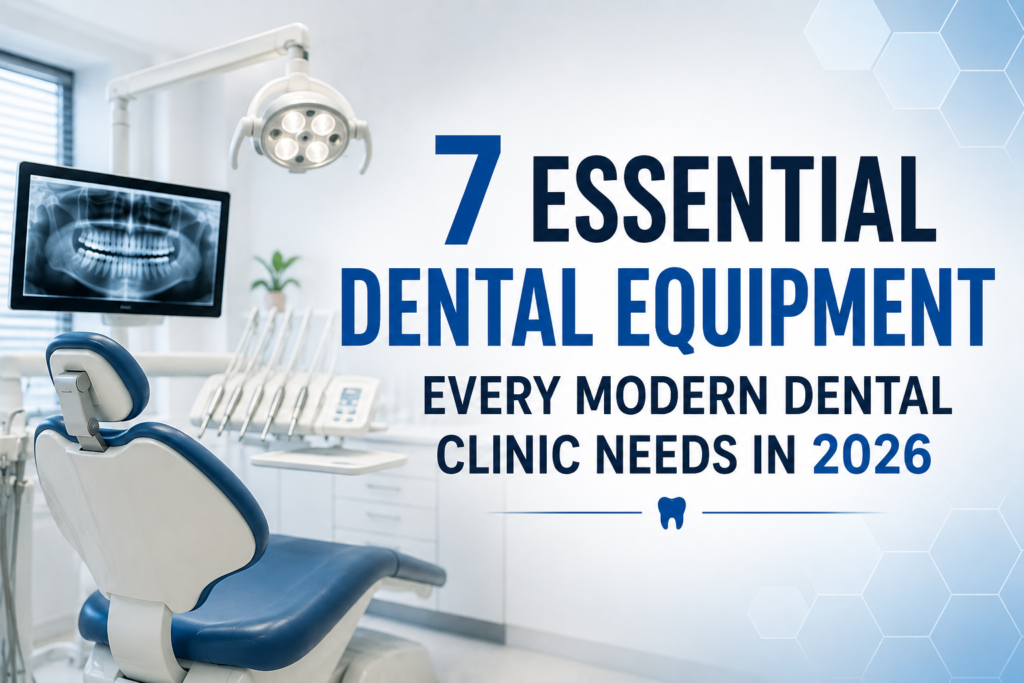
The dental industry is evolving faster than ever before. Patients today expect accurate diagnosis, minimally invasive treatment, faster appointments, and a comfortable clinical experience. At the same time, dentists are looking for technologies that improve efficiency, reduce chair time, and deliver predictable treatment outcomes. This shift has made investing in the essential dental equipment a necessity rather than a luxury.
A modern dental clinic is no longer defined by its location or interiors—it is defined by the technology it uses. From digital imaging systems and intraoral scanners to dental lasers and AI-powered software, advanced equipment enables dentists to diagnose conditions earlier, plan treatments with greater precision, and provide a superior patient experience.
In this guide, we’ll explore the 10 essential dental equipment every modern dental clinic should consider in 2026 and explain how each technology contributes to clinical excellence and practice growth.
Why Investing in Modern Dental Equipment Matters
Technology has transformed the way dentistry is practiced. Traditional workflows that relied on manual impressions, film-based X-rays, and lengthy treatment planning are rapidly being replaced by digital solutions that improve both clinical efficiency and patient satisfaction.
Modern equipment offers several advantages:
- Faster diagnosis and treatment planning
- Improved diagnostic accuracy
- Enhanced patient comfort
- Better communication with patients and dental laboratories
- Reduced chair time
- Increased workflow efficiency
- Higher treatment acceptance rates
- Long-term cost savings
Clinics that invest in digital technologies are often better equipped to meet patient expectations while maintaining a competitive edge in today’s dental industry.
1. CBCT Machine – The Foundation of Advanced Dental Imaging
Among all dental imaging technologies, the CBCT (Cone Beam Computed Tomography) machine has become one of the most valuable investments for modern dental clinics. Unlike traditional two-dimensional X-rays, CBCT provides detailed three-dimensional images of the teeth, jawbone, nerves, airways, and surrounding anatomical structures.
This level of detail is essential for procedures that require precision, including dental implant planning, orthodontics, endodontics, oral surgery, and TMJ analysis. With accurate 3D visualization, dentists can evaluate bone quality, identify anatomical limitations, and create safer treatment plans.
Key Benefits of a CBCT Machine
- High-resolution 3D imaging
- Accurate implant planning
- Better diagnosis of complex cases
- Improved patient communication
- Reduced surgical risks
- Enhanced treatment predictability
2. RVG Sensor – Faster and Smarter Digital X-rays
Digital radiography has become a standard in modern dentistry, making the RVG (RadioVisioGraphy) Sensor one of the most essential pieces of equipment for any dental practice.
Unlike traditional film-based X-rays, RVG sensors capture high-resolution digital images within seconds. Dentists can instantly enlarge, enhance, and analyze images, improving diagnostic accuracy while reducing treatment delays.
The ability to store images digitally also simplifies patient record management and allows seamless collaboration with specialists.
Why Every Clinic Needs an RVG Sensor
- Instant image acquisition
- Lower radiation exposure
- Superior image quality
- Digital image enhancement
- Easy storage and sharing
- Environmentally friendly workflow
An RVG sensor not only improves clinical efficiency but also enhances the overall patient experience by reducing waiting time and providing immediate visual explanations.
3. Intraoral Scanner – The Future of Digital Impressions
Traditional dental impressions are gradually being replaced by Intraoral Scanners (IOS), offering a faster, cleaner, and more comfortable experience for both dentists and patients.
An intraoral scanner captures highly accurate digital impressions in just a few minutes, eliminating the need for impression trays and materials. These digital scans can be sent instantly to dental laboratories, reducing turnaround time for crowns, bridges, aligners, and implant restorations.
In addition to improving workflow efficiency, intraoral scanners help reduce remakes caused by inaccurate impressions, ultimately saving time and operational costs.
Benefits of Intraoral Scanners
- Improved patient comfort
- Faster treatment workflow
- Highly accurate digital impressions
- Better communication with dental labs
- Reduced remakes and adjustments
- Increased patient satisfaction
As digital dentistry continues to evolve, intraoral scanners have become an essential investment for practices focused on restorative, prosthodontic, and orthodontic treatments.
4. OPG Machine – Comprehensive Panoramic Imaging
An Orthopantomogram (OPG) machine provides a panoramic view of the patient’s teeth, jaws, temporomandibular joints (TMJ), and surrounding structures in a single image. It is an indispensable diagnostic tool for routine dental examinations and treatment planning.
OPG imaging is widely used for evaluating impacted teeth, jaw fractures, cysts, orthodontic assessments, periodontal conditions, and overall oral health. Compared to multiple intraoral X-rays, an OPG offers a broader perspective while improving patient convenience.
Advantages of an OPG Machine
- Full panoramic view of the oral cavity
- Quick and comfortable imaging
- Useful for orthodontic planning
- Detects impacted teeth and jaw abnormalities
- Supports preventive dental care
5. Dental Lasers – Minimally Invasive Dentistry Is the Future
One of the fastest-growing trends in modern dentistry is the adoption of Dental Lasers. From routine soft tissue procedures to cosmetic treatments, laser technology enables dentists to perform procedures with greater precision while improving patient comfort.
Unlike conventional surgical methods that often require scalpels and sutures, dental lasers use focused light energy to treat soft tissues with minimal trauma. This results in less bleeding, reduced swelling, and significantly faster healing.
As patients increasingly look for painless and minimally invasive treatments, incorporating a dental laser into your practice can enhance both clinical outcomes and patient satisfaction.
Common Applications of Dental Lasers
- Gingivectomy
- Frenectomy
- Crown lengthening
- Soft tissue contouring
- Periodontal therapy
- Implant uncovering
- Aphthous ulcer treatment
- Teeth whitening (depending on the laser system)
Why Invest in a Dental Laser?
- Minimal bleeding during procedures
- Faster healing and recovery
- Reduced postoperative discomfort
- Greater clinical precision
- Improved patient experience
- Shorter chair time
6. Intraoral Camera – Enhancing Diagnosis and Patient Communication
A diagnosis is much easier to understand when patients can actually see the problem. This is where an Intraoral Camera becomes an invaluable tool.
An intraoral camera captures high-definition images of the patient’s teeth, gums, and oral tissues in real time. These images can be displayed instantly on a monitor, allowing dentists to explain conditions such as cavities, fractures, plaque buildup, or worn restorations.
When patients can clearly visualize their oral condition, they are more likely to understand the recommended treatment and accept the proposed treatment plan.
Benefits of an Intraoral Camera
- High-quality clinical images
- Improved patient education
- Better treatment acceptance
- Easy documentation
- Enhanced communication with specialists
7. CAD/CAM System – Same-Day Restorations
The demand for faster and more convenient dental care continues to grow. A CAD/CAM (Computer-Aided Design and Computer-Aided Manufacturing) system allows dentists to digitally design and fabricate restorations with exceptional precision.
Combined with an Intraoral Scanner, CAD/CAM technology creates a seamless digital workflow that significantly reduces turnaround time for crowns, bridges, veneers, inlays, and onlays.
Advantages of CAD/CAM Dentistry
- Digital precision
- Reduced treatment time
- Improved restoration fit
- Fewer patient appointments
- Better aesthetics
- Efficient workflow
Although the initial investment may be higher, CAD/CAM systems improve productivity and deliver a premium patient experience.
Conclusion
The future of dentistry is digital, and investing in the essential dental equipment is no longer optional for clinics that want to provide high-quality, efficient, and patient-centered care. Technologies such as CBCT machines, RVG sensors, intraoral scanners, OPG systems, dental lasers, and AI-powered software are transforming the way dentists diagnose, plan treatments, and communicate with patients.
While every clinic has different requirements based on its specialties and patient volume, building a digital workflow can significantly improve productivity, reduce treatment time, and enhance clinical accuracy. More importantly, it creates a better patient experience—one of the most important factors in growing a successful dental practice.
As dentistry continues to evolve in 2026 and beyond, choosing reliable, future-ready technology will help your clinic stay competitive while delivering exceptional standards of care.
If you’re planning to upgrade your practice, Vatech India offers a complete range of advanced dental imaging solutions, including CBCT systems, RVG sensors, Intraoral Scanners, OPG machines, and Dental Lasers, designed to support every stage of modern dental diagnosis and treatment.
Frequently Asked Questions
Most frequent questions and answers
Why is a CBCT machine important for dentists?
A CBCT machine provides detailed 3D images of the teeth, jawbone, nerves, and surrounding structures. It is widely used for implant planning, oral surgery, orthodontics, endodontics, and complex case diagnosis, offering greater accuracy than traditional 2D imaging.
How does an RVG sensor improve dental diagnosis?
An RVG sensor captures digital X-ray images instantly, allowing dentists to view, enlarge, and enhance images within seconds. It also reduces radiation exposure and eliminates the need for film processing, making diagnosis faster and more efficient.
Are intraoral scanners better than traditional impressions?
Yes. Intraoral scanners provide highly accurate digital impressions while improving patient comfort. They eliminate the need for messy impression materials and create a faster digital workflow for restorations, aligners, and implant cases.
How does AI benefit modern dental clinics?
AI-powered dental software assists dentists by analyzing radiographs, supporting treatment planning, organizing patient records, and improving workflow efficiency. It enhances clinical decision-making while saving valuable time.


