
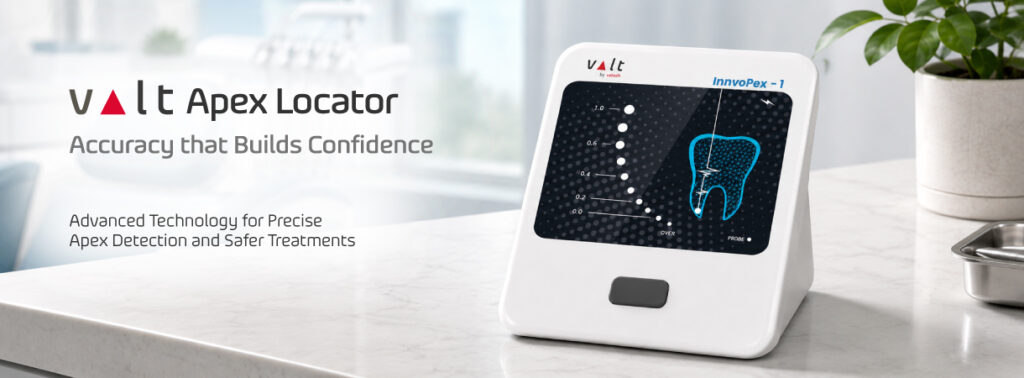
Root canal treatment is one of the most technique-sensitive procedures in dentistry. One of the most important steps in successful endodontic treatment is determining the correct working length of the root canal. Accurate working length helps dentists clean, shape, and obturate the canal effectively while reducing the risk of over-instrumentation or inadequate cleaning.
This is where an apex locator becomes an important part of modern endodontic practice.
An apex locator is an electronic dental device designed to help determine the position of the apical constriction and estimate the working length of a root canal. By providing real-time information during treatment, an electronic apex locator can support greater precision and efficiency during root canal procedures.
What Is an Apex Locator?
An apex locator is an electronic device used in endodontics to determine the approximate position of the root canal apex. It works by measuring electrical characteristics within the root canal and helps the dentist identify the location of the file relative to the apical region.
Traditionally, dentists have relied on radiographs, tactile sensation, and clinical experience to estimate working length. While radiographs remain an important diagnostic tool, an apex locator provides additional information during the procedure.
Modern electronic apex locators are designed to provide continuous or near real-time measurements, helping dentists make more informed decisions while preparing the root canal.
Why Is Working Length Important in Root Canal Treatment?
Working length determination is a critical step in root canal treatment. The objective is to establish the length at which cleaning and shaping should be performed while maintaining control of the apical region.
If the working length is too short, parts of the root canal may remain inadequately cleaned or disinfected. On the other hand, excessive instrumentation beyond the desired endpoint can potentially cause unnecessary irritation to the surrounding tissues.
Accurate working length determination therefore plays an important role in predictable endodontic treatment.
An apex locator can help dentists assess working length during the procedure and complement radiographic evaluation.
How Does an Electronic Apex Locator Work?
An electronic apex locator uses electrical measurements to estimate the position of the file inside the root canal.
During the procedure, the dentist places an endodontic file into the canal and connects it to the apex locator. The device measures changes in electrical characteristics as the file approaches the apical region.
The information is then displayed on the device, allowing the dentist to monitor the file position.
The exact technology varies between apex locator models. Modern devices may use advanced measurement methods designed to improve performance under different canal conditions.
However, an apex locator should be considered a clinical aid rather than a replacement for the dentist’s judgement, radiographs, and appropriate endodontic techniques.
Key Benefits of Using an Apex Locator
1. Improved Working Length Determination
One of the biggest advantages of an apex locator is its ability to assist with working length determination. Having an electronic measurement during treatment can help dentists establish an appropriate endpoint for canal preparation.
2. Real-Time Measurement
Unlike methods that provide information only after an image is taken, an electronic apex locator can provide measurements while the procedure is being performed.
This can help dentists monitor file position throughout the treatment.
3. Supports More Predictable Endodontic Treatment
Accurate canal preparation is an important part of successful root canal treatment. By assisting with working length determination, an apex locator can support a more controlled endodontic workflow.
4. Complements Radiographic Evaluation
An apex locator does not necessarily replace dental X-rays. Instead, it can complement radiographic assessment by providing electronic information about the file position inside the canal.
Using multiple sources of clinical information can help dentists make better treatment decisions.
5. Helps Improve Treatment Efficiency
Modern dental practices increasingly focus on efficient workflows without compromising clinical quality. An electronic apex locator can help streamline the working length determination process and reduce dependence on repeated estimation.
Apex Locator vs. Traditional Working Length Methods
Radiographs have been widely used for working length estimation in endodontics. However, a two-dimensional radiographic image may not always provide complete information about the three-dimensional anatomy of the root canal system.
An apex locator provides another source of information by electronically assessing the position of the file within the canal.
For this reason, the question is not necessarily whether dentists should choose an apex locator or radiographs. In many clinical situations, these methods can work together.
The dentist can use clinical examination, radiographs, electronic measurements, and clinical judgement to establish an appropriate working length.
When Should Dentists Consider Using an Apex Locator?
An apex locator can be useful across a wide range of root canal procedures. It may be particularly helpful when accurate working length determination is challenging because of complex root canal anatomy.
Curved canals, overlapping anatomical structures, and limitations of conventional radiographic interpretation can make endodontic procedures more demanding.
Having an electronic measurement tool available can give dentists additional information during canal preparation.
As with any dental equipment, proper use, calibration or device-specific protocols, and clinical judgement are important for obtaining reliable results.
How to Choose the Right Dental Apex Locator
When selecting a dental apex locator, dentists should consider several factors rather than focusing on a single feature.
Look for a device that offers:
- Accurate and consistent measurements
- A clear and easy-to-read display
- Simple operation
- Reliable performance in different clinical conditions
- Convenient file connection and handling
- A compact design suitable for everyday practice
- Easy maintenance and cleaning
- Reliable technical and after-sales support
The right apex locator should fit naturally into the dentist’s existing endodontic workflow.
Conclusion
An apex locator has become an important technology in modern endodontics because it assists dentists in determining root canal working length with electronic measurements.
By providing real-time information about file position, an electronic apex locator can complement radiographs and clinical assessment, helping dentists achieve a more controlled and efficient root canal procedure.
Ultimately, successful root canal treatment depends on several factors, including diagnosis, case selection, access preparation, cleaning and shaping, irrigation, obturation, and clinical expertise. An apex locator is one of the tools that can support dentists in achieving greater precision during this process.
For dentists looking to improve their endodontic workflow, understanding how an apex locator works and how it can complement conventional methods is an important step toward more predictable root canal treatment.


